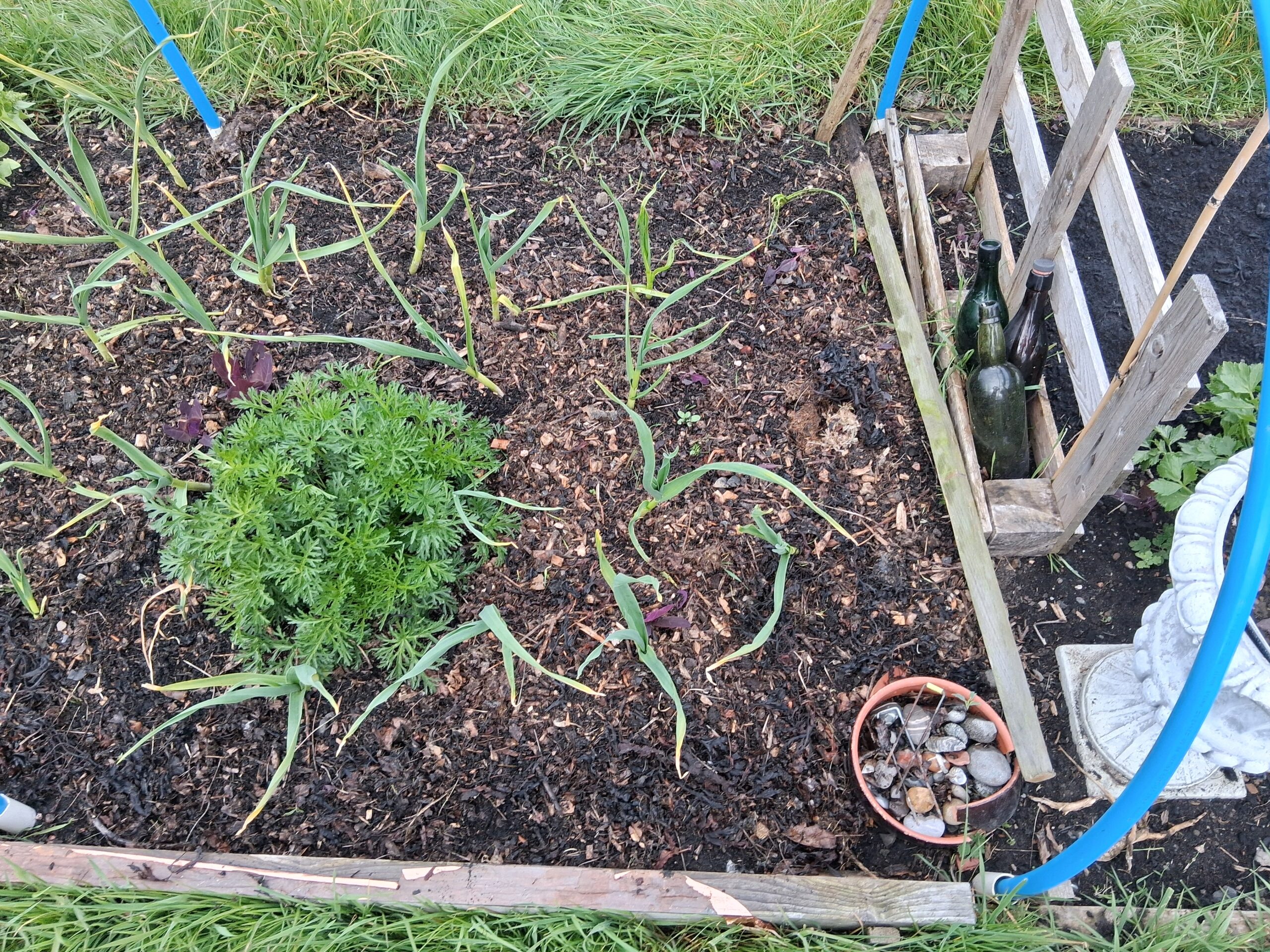
Following the appearance of the mystery feverfew plant in the garlic bed, it seems there may be a few more interesting self-seeded “incomers” appearing around the allotment too.
One of the most noticeable is a striking purple-leaved plant that seems to be popping up in several places around the plots. At first glance it almost looks ornamental, but after a bit of investigation — and a useful conversation with another grower at Lauriston Farm — it now seems likely that some of these seedlings may actually be Amaranth, with possibly a little Red Orach appearing too.
Both plants are attractive, edible and well suited to wildlife-friendly community growing spaces.
🌱 Amaranth — A Global Leafy Crop
Amaranth (Amaranthus species) is grown widely around the world, particularly in Africa, Asia and Central America, where it is often valued as an important leafy vegetable rather than simply an ornamental plant.
The young leaves can be cooked much like spinach and are commonly added to soups, stews and stir fries. Later in the season the plants can become extremely dramatic, producing tall stems and colourful tassel-like seed heads that sway above the beds and attract birds and pollinators.
Once introduced into a community allotment, amaranth often self-seeds very easily, especially in mulched or compost-rich beds.
It is easy to see why experienced growers like to keep it around:
- edible leaves
- beautiful colour
- wildlife value
- architectural structure
- resilience in difficult conditions
🍃 Red Orach — The “Mountain Spinach”
There may also be some Red Orach (Atriplex hortensis) appearing amongst the volunteers.
Sometimes called “mountain spinach” or “French spinach,” red orach is an old cottage-garden crop with deep reddish-purple leaves and a softer, more airy growth habit than amaranth.
Like amaranth, it is edible and can be used as a leafy green. It is also much more tolerant of warmer weather than true spinach, which often bolts quickly once temperatures rise.
The two plants can look surprisingly similar as seedlings, especially when emerging through mulch and wood chip.
🌼 Learning to Observe Before Removing
As the allotment matures, more self-seeded plants seem to appear each season. At first it is tempting to remove every unexpected seedling immediately, but one of the lessons of no-dig and community growing is that not every volunteer is a problem.
Some turn out to be:
- edible crops
- pollinator-friendly flowers
- useful companion plants
- or simply beautiful additions to the biodiversity of the plot.
A few self-seeded incomers are probably nothing to worry about — a bit like people really.
The trick is perhaps not total control, but gentle editing. Some things stay, some things go, and over time the allotment slowly develops its own character and ecology.