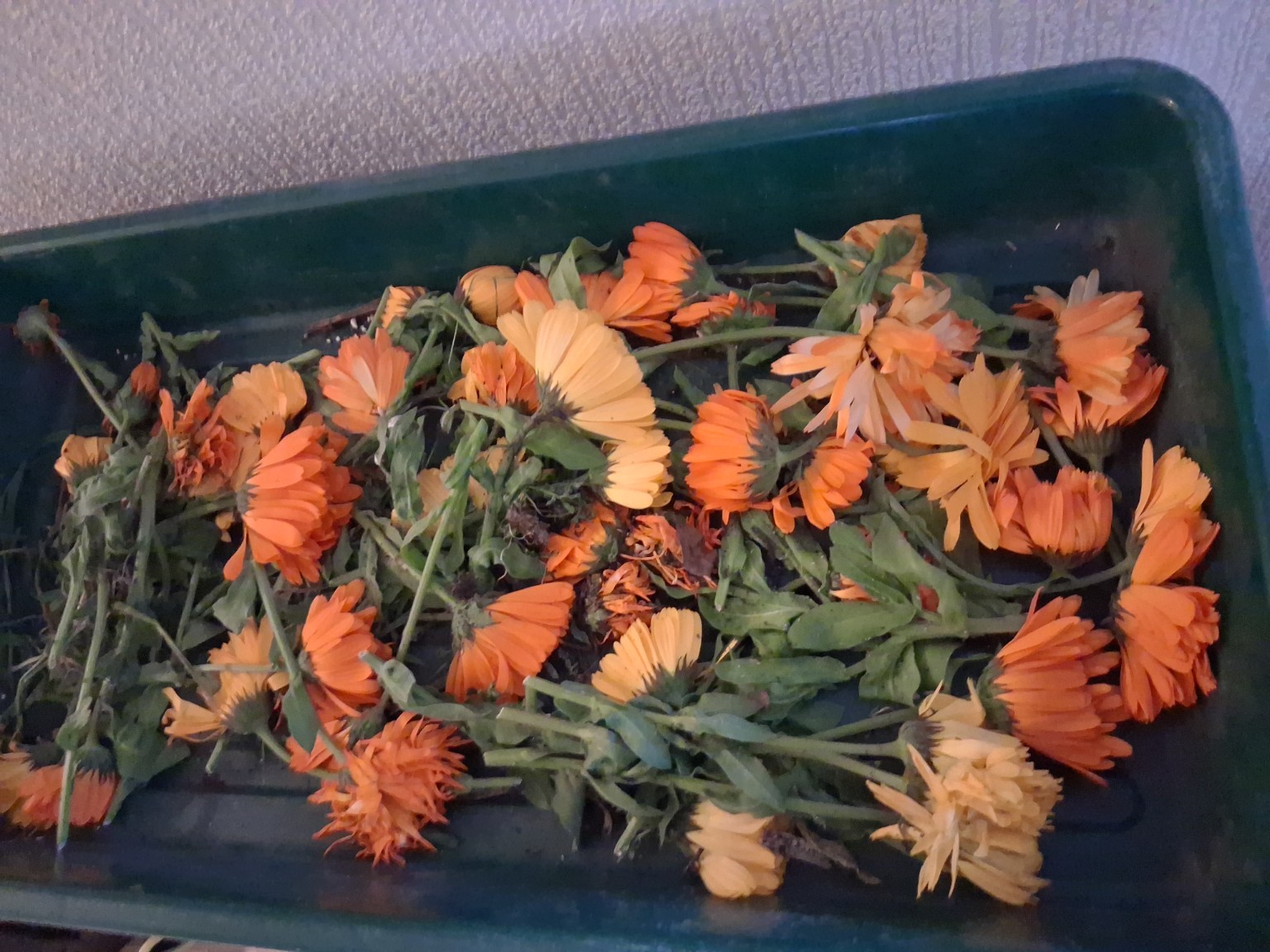
Calendula is one of the most useful “extra” flowers to have. Assuming they are pot marigold / calendula rather than ornamental French/African marigold, you can use them in several ways.
1. Dry the petals for tea, cooking or colour
Pull the petals from the flower heads and spread them on a tray, plate or paper towel somewhere warm, dry and airy. Once fully crisp, store them in a jar.
You can use dried petals for:
- herbal tea blends
- scattering over salads
- rice, couscous or soups for colour
- homemade “poor man’s saffron” colour in cooking
- adding to bath salts or soap projects
I’d avoid using the green flower bases in food because they can be more bitter.
2. Make calendula oil
This is probably the best use if you have a good handful.
Let the flowers wilt/dry for a day or two first so there is less moisture. Then put petals or partly dried flower heads into a clean jar and cover with oil — olive, sunflower or sweet almond oil all work. Leave somewhere warm but not scorching for 2–4 weeks, shaking now and then. Strain and keep the oil.
Useful as a simple skin oil for dry hands, gardener’s knuckles, rough elbows, etc. Don’t use it on deep wounds or anything infected.
3. Freeze petals in ice cubes
Very easy and quite satisfying. Pull off the petals and freeze them in ice cube trays with water. Nice for summer drinks, elderflower cordial, or anything that wants a bit of colour.
4. Save some seed
If any heads are starting to go over, leave a few on the plant if possible until they form those curled, chunky seeds. Calendula is very easy to save and often self-seeds cheerfully.
5. Use them as a companion flower
Fresh or dried petals can go into your allotment/site photos and harvest shots — they look great alongside veg. In the ground, calendula is also useful for pollinators and makes a good companion flower around vegetables.
6. Compost the rest
Anything damaged, soggy, or not worth drying can go straight into compost. They’ll break down nicely.
For this batch, I’d probably pull off the best petals and dry them, then maybe make a small jar of calendula oil with the rest. They’d also make a nice little “From Plot to Pot” post: What to do with a tray of calendula flowers.
Make a wordpress post all about calendula and its uses in my allotment.website style and use that photo for fimage and intro post by saying; Spent the afternoon tidying the calendula border in my garden.. the more you cut the more will grow.. these ate too full to vase but all is not lost… Thought for a second
Absolutely — here’s a WordPress-ready post in your usual From Plot to Pot style.
Calendula: The Flower That Keeps Giving
Featured image: use your tray of picked calendula flowers.
Spent the afternoon tidying the calendula border in my garden. The more you cut, the more will grow — which is one of the great joys of calendula. These were too full, floppy and past their best for a vase, but all is not lost. In fact, calendula is one of those wonderfully useful allotment and kitchen garden flowers where even the trimmings can still earn their keep.
Calendula, often called pot marigold, is bright, cheerful, easy to grow, loved by pollinators, useful in the garden, and surprisingly handy in the kitchen and home. It is exactly the sort of plant that fits well into a mixed organic allotment: beautiful, practical, forgiving and generous.
What is calendula?
Calendula is an annual flowering plant, usually producing orange, yellow or apricot daisy-like flowers over a long season. It is sometimes confused with French or African marigolds, but calendula is a different plant.
The one usually grown for edible and herbal uses is Calendula officinalis — the traditional pot marigold.
It grows quickly from seed, self-seeds readily, flowers for months, and responds brilliantly to regular picking. Rather than sulking when cut, it often produces even more flowers.
Why grow calendula on an allotment?
Calendula earns its space in several ways.
It brings colour to the plot, attracts pollinators, fills gaps between crops, and gives you a steady supply of edible petals. It can be grown along bed edges, in pots, around brassicas, beside beans, or in any sunny corner that needs cheering up.
It is also a good “soft landing” plant for a no-dig allotment. Scatter seed, cover lightly, water in, and it will usually get on with things. Once established, it is not fussy.
Good for pollinators
Calendula flowers are open and accessible, so bees, hoverflies and other insects can make good use of them. In a vegetable garden, that matters.
The more flowering plants we have around our crops, the more life the plot supports. Calendula is especially useful because it flowers over a long period and keeps producing if regularly deadheaded or picked.
It is one of those plants that helps make an allotment feel less like a production line and more like a living garden.
Cut and come again
One of the best things about calendula is that picking the flowers encourages more to form.
If flowers are left to go fully to seed, the plant may slow down. But if you keep cutting the flowers — whether for a vase, drying, petals, seed saving or simply tidying — the plant usually responds by making more buds.
So a tray of slightly overblown flowers is not a failure. It is part of the cycle.
Using calendula petals in the kitchen
Calendula petals are edible and can be used fresh or dried.
They do not have a strong flavour, but they add a warm colour and a gentle peppery note. The petals can be scattered over salads, soups, rice dishes, couscous, pasta, omelettes or roasted vegetables.
They are sometimes called “poor man’s saffron” because the petals can give a golden colour to food, though they do not taste like saffron.
For eating, it is best to pull the petals away from the green flower base, as the base can be more bitter.
Drying calendula
Drying is probably the easiest way to make use of a big handful of flowers.
Pull the petals from the heads and spread them out on a tray, plate, clean cloth or sheet of paper. Leave them somewhere warm, dry and airy until they are completely crisp.
Once fully dry, store them in a clean jar.
Dried calendula petals can be used in:
- herbal tea blends
- soups and stews
- rice and grain dishes
- homemade bath salts
- soaps and salves
- decorative edible sprinkles for salads and summer dishes
Make sure they are fully dry before storing, otherwise they can go mouldy in the jar.
Calendula tea
Calendula petals can be used in herbal tea, either on their own or mixed with other herbs such as mint, lemon balm, chamomile or fennel seed.
Use a small pinch of dried petals in a cup, pour over boiling water, and leave to steep for several minutes. The result is gentle, golden and very garden-like.
As with all herbal uses, it is sensible to start small and avoid using it medicinally without checking suitability, especially during pregnancy, with allergies, or if taking medication.
Calendula oil for gardener’s hands
Calendula is often used in skin oils and balms. A simple homemade calendula oil is easy to make.
Let the flowers wilt or partly dry first, as too much moisture in oil can cause spoilage. Then place dried or partly dried petals into a clean jar and cover them with oil. Olive oil, sunflower oil or sweet almond oil can all be used.
Leave the jar somewhere warm for a few weeks, shaking it now and again. Then strain the oil and store it in a clean bottle or jar.
This can be used as a simple oil for dry hands, rough skin and general gardener’s wear and tear. It should not be used on deep cuts, infected skin or anything that really needs medical attention.
Saving calendula seed
Calendula is very easy to save seed from.
Leave some flowers on the plant until they dry and form curled, chunky seeds. Once the seed heads are dry, collect them and store them in a paper bag or envelope somewhere cool and dry.
You may not even need to sow them deliberately next year. Calendula often self-seeds and pops up where it is happy. Any unwanted seedlings are easy to move, thin or compost.
Growing calendula
Calendula is straightforward from seed.
Sow direct into the soil from spring onwards, or start in modules if you want more control. It likes sun, but will tolerate a bit of light shade. It does not need rich soil and often does well in ordinary garden conditions.
For a long season of flowers:
- sow in spring for summer flowers
- keep picking or deadheading
- leave a few late flowers for seed
- allow some self-seeding if you like a natural cottage-garden feel
It also grows well in pots, which makes it useful for patios, paths, front gardens and spare containers around the plot.
A good flower for organic growing
For an organic allotment, calendula fits beautifully. It brings in insects, covers soil, looks cheerful, provides edible petals, and gives you useful plant material without needing sprays, feeds or fuss.
It is not a magic pest cure — no companion plant is — but it helps create a more balanced, diverse growing space. And that is often the real benefit.
A plot with flowers, herbs, vegetables, seed heads, insects and birds feels healthier than bare soil and rows of crops alone.
What I’ll do with this batch
This tray of calendula flowers may not be vase-perfect, but they are still useful.
The best petals can be pulled off and dried for the kitchen. Some can be used fresh in salads or scattered over dishes. A handful could go into a small jar of oil. Anything too far gone can go straight into the compost.
Nothing wasted.
From plot to pot — and back again
Calendula is one of those plants that closes the loop nicely. It grows easily, feeds insects, brightens the garden, gives petals for the kitchen, offers seed for next year, and finally returns to the compost heap.
Not bad for a flower that some people might simply throw away.
And the best bit? The more you cut, the more it grows.
Suggested excerpt:
Spent the afternoon tidying the calendula border. These flowers were too full for a vase, but far too useful to waste — calendula is edible, easy to dry, loved by pollinators and perfect for an organic allotment.
Suggested categories: Plot, Tools & Tips, Organic Growing
Suggested tags: calendula, pot marigold, edible flowers, pollinators, companion planting, seed saving, no-dig gardening, organic allotmentThought for a second
Yes — that pairing works really well:
Bloggy post:
Use the longer calendula article as the personal story/update: tidying the border, tray of flowers, “too full for a vase but not wasted”, then all the uses.
Seed Bank / catalogue entry:
Use the shorter card as the practical reference page: sowing, growing, uses, harvesting and seed saving.
That gives you the best of both worlds:
The post feels like From Plot to Pot — personal, seasonal, reflective, useful.
The Seed Bank card becomes the evergreen reference people can come back to later.
You could link them both ways too:
At the end of the blog post:
For growing notes, sowing times and seed-saving information, see the Calendula Seed Bank card.
And on the Seed Bank card:
See also: Calendula — the flower that keeps giving, for more ideas on using calendula flowers from the garden.
That will help the site feel nicely connected rather than just a set of separate posts.
A recipe using them next i guess or a potionThought for a second
Yes — calendula almost demands either a recipe or a slightly witchy but perfectly respectable gardener’s potionnext.
For your site, I’d do both eventually, but the best next one is probably:
Calendula Oil: A Simple Gardener’s Potion for Dry Hands
That fits the photo, the allotment theme, and the “nothing wasted” angle beautifully.
Basic calendula oil
Pick over the flowers and remove anything brown, soggy or obviously past it. Pull off the petals, or use the whole flower heads if they are clean and in decent condition.
Spread them on a tray for a day or two first. This is important because fresh flowers contain moisture, and moisture trapped in oil can encourage mould.
Once partly dried, put the petals into a clean jar and cover with oil.
Good oils to use:
- sunflower oil — light, simple, inexpensive
- olive oil — heavier, but good for rough gardener’s hands
- sweet almond oil — lovely, but more expensive
Make sure the petals are fully covered. Put the lid on, leave somewhere warm but not in strong direct sun, and shake gently every day or two.
After 2–4 weeks, strain through a clean cloth or fine sieve and bottle the golden oil.
You can use it as a simple hand oil after gardening, or as the base for a balm if you later melt it with a little beeswax.
Safety note for the post
Worth adding something like:
This is a traditional home use rather than medical advice. Don’t use homemade oils on deep cuts, infected skin, or anything that needs proper treatment. If you have sensitive skin or plant allergies, test a tiny amount first.
A simple edible recipe idea
For a first calendula recipe, I’d go very simple:
Calendula butter
Soften butter, mix in fresh calendula petals, a little lemon zest, black pepper and a pinch of salt. Roll it in greaseproof paper and chill.
Use on:
- new potatoes
- steamed greens
- courgettes
- toast
- sweetcorn
- roasted carrots
That would make a nice “Plot to Pot” recipe because it uses the petals in a way that is easy, colourful and not pretending they taste like something they don’t. They are mostly about colour, cheerfulness and a gentle herbal note.
My vote: do the gardener’s calendula oil/potion post first, then a calendula butter recipe as the follow-up.
Ok
Good plan. I’d line them up like this:
- Main blog post: Calendula: The Flower That Keeps Giving
- Seed Bank card: Calendula / Pot Marigold
- Follow-up post: Calendula Oil: A Simple Gardener’s Potion for Dry Hands
- Recipe post: Calendula Butter for New Potatoes and Summer Veg
That gives you a neat little mini-series: grow it, value it, preserve it, cook with it.